
Gem County Deed Types
Deeds live inside a broader recorded-document index at the recorder's office. Filters group results as deeds, assignments, judgments, and liens. So the label on a row matters. A deed transfers an interest in land. A lien or judgment can burden property without conveying anything. Read the instrument, the parties, and the legal description together before drawing any conclusion about who holds title.
| Deed Type | What It Does | Common Use |
|---|---|---|
| Warranty deed | Conveys the stated interest with covenants in the instrument | Ordinary arm's-length transfer |
| Quitclaim deed | Conveys whatever interest the grantor may hold | Interest cleanup or related-party transfer |
| Trustee or estate deed | Conveys under trust or estate authority | Trust administration or probate sale |
| Tax deed | Records a transfer after the required tax process | Completed delinquent-tax proceeding |
| Release or reconveyance | Records release of a prior security interest | Following payoff of a secured debt |
Labels are only clues. The text governs. The recorder's fee page lists trust deeds or mortgages, reconveyances or releases, deeds, copies, and certification as separate items. That separation helps a researcher avoid mistaking a release for a new sale or a notice for a completed transfer.
Search Gem County's Index
The Gem County Recorded Documents Index offers five ways into deed records. Start narrow when an instrument number is known. With a party name, follow the portal's last-name, first-name format. Try a useful fragment when spelling varies. A description can be a subdivision, lot, block, or section. It can also be any phrase from the legal description.
| Search control | How it works | Best evidence to have |
|---|---|---|
| Instrument # | Direct document lookup | Number from map, deed, or notice |
| Document type | Filters assignments, deeds, judgments, or liens | Known record class |
| Name | Uses last name, first name order | Grantor or grantee name |
| Description | Matches indexed land wording | Subdivision, lot, block, or section |
| Date pair | Requires both from and to dates | A sound transfer window |
The official search instructions require at least one field, both dates for a date search, and a match on every fact supplied. Guessing too many facts can hide a valid row. Broad searches also run slowly. The portal page displays the controls used for Gem County deed records, and saving your search terms with the date of access keeps the result useful later.
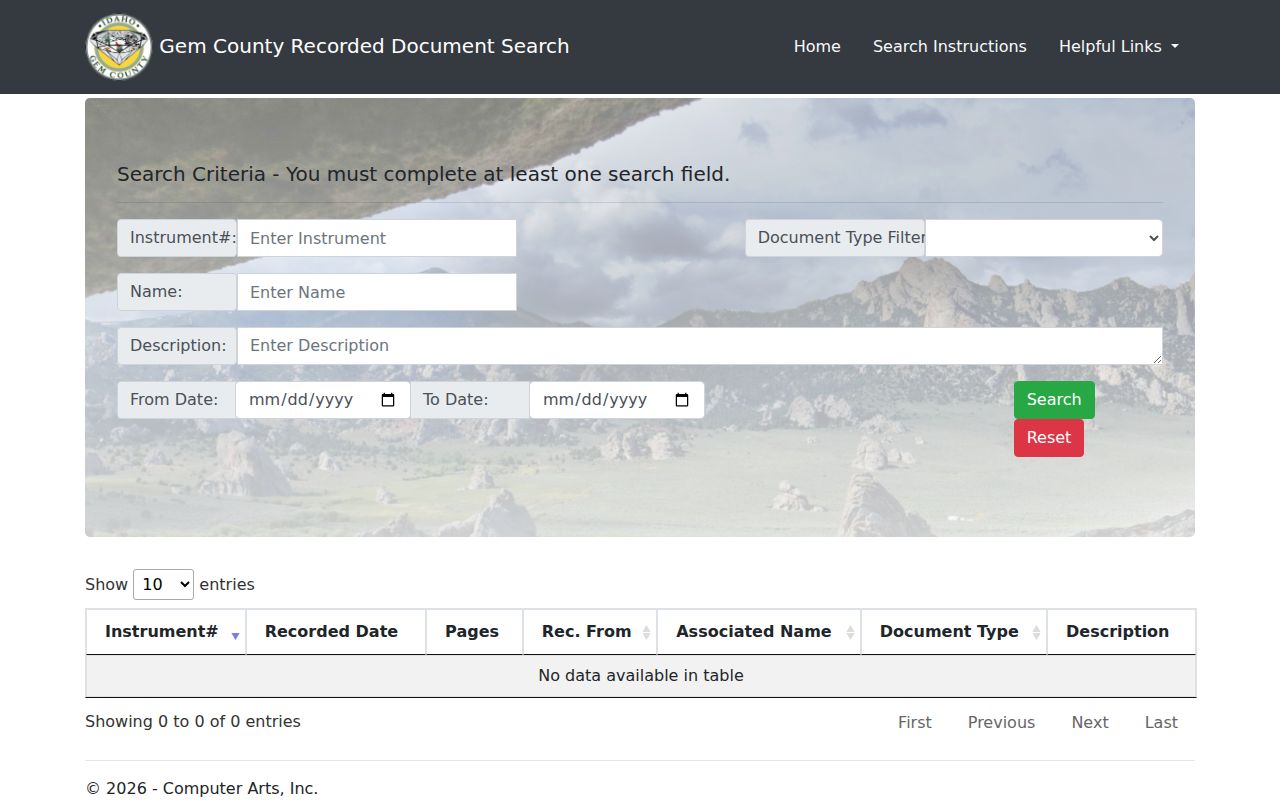
The form shows that name, description, type, date, and instrument searches all share one index at the Gem County recorder.
Read a Gem County Result
A result row may list an instrument number, recorded date, page count, the party who submitted the document, an associated name, document type, and description. Those fields help screen candidates. They do not replace the instrument itself. Open the detail and compare the date, party roles, and legal description. Instrument 331389 offers a concrete example. Its detail identifies a two-page warranty deed dated January 5, 2021, received from Pioneer Title Company of Gem County. It describes Lot 1, Block 1, Sosoni Place Subdivision. Hallson Development LLC is the grantor. Brian Ellis and Carrie Jean Ellis are the grantees. The official instrument detail gives Gem County deed research a working test case for party roles and the indexed description.
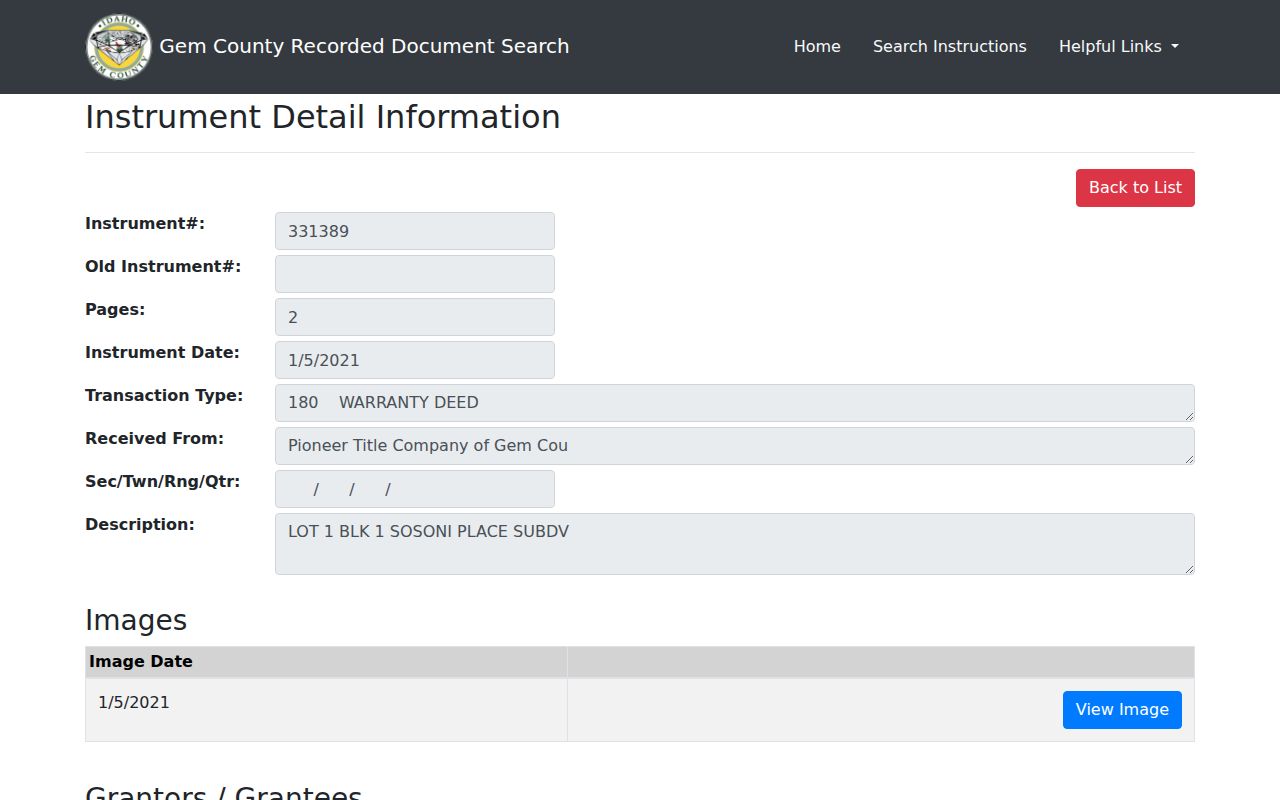
The detail ties one instrument number to named parties and a single parcel description. That is exactly the link the next chain step needs.
Build Gem County's Deed Chain
A chain of title is the ordered run of instruments that transferred the same land. Start with the newest deed tied to the parcel. Then work back through the party who conveyed it. Names alone are weak evidence. People and entities often share names. The legal description and the recording sequence keep the chain attached to the land itself.
- Use the parcel map's deed reference or a known owner to find the newest plausible instrument.
- Open the detail and write down the grantor, grantee, instrument date, recording date, and full land description.
- Search the grantor as an earlier grantee, then test the same description and a sensible prior date range.
- Repeat until a gap, predecessor county, parent parcel, trust, or estate transfer calls for another source.
- Grantor
- The party that conveys the stated interest.
- Grantee
- The party that receives the stated interest.
- Chain of title
- The linked sequence of recorded transfers for the same land.
- Instrument number
- The recorder's unique reference for a recorded document.
- Book and page
- An older reference that locates a record in bound or filmed volumes.
Gem County Records Reach 1900
Online Gem County deed records reach 1900, but the recorder publishes no official cutoff. Searches for 1895 through 1899 return no hits in the portal. That is a search result, not proof that earlier instruments never existed. One 1900 row is sparse. Another names John Wittel, a warranty deed, and Book 2, Page 432. The 1900 result set shows why old rows demand care: sparse names, zero-page entries, and book-page wording may need help from the clerk or an archive.
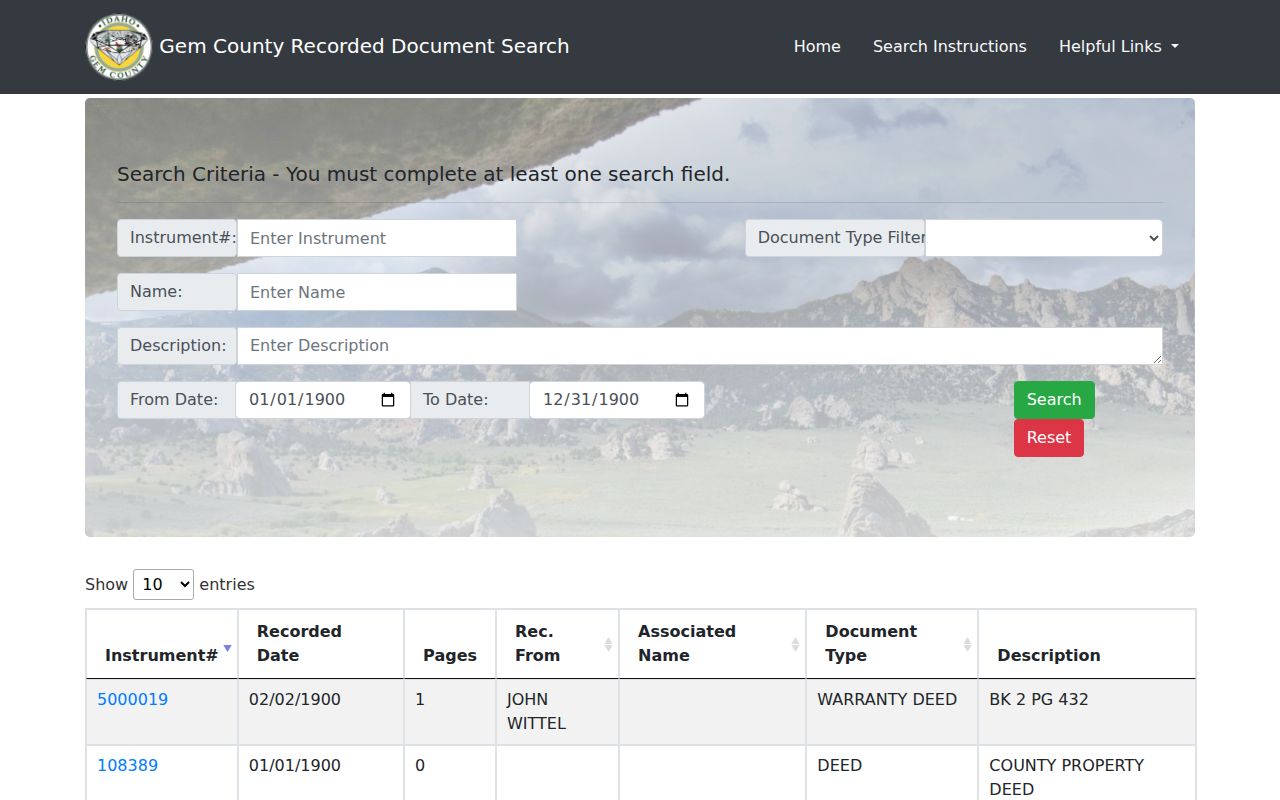
That result shows only the earliest year visible online. It does not mark the first deed ever recorded for the land.
Online coverage has no stated cutoff. Treat 1900 as the earliest observed result and ask the recorder or archives about gaps and older volumes.
Before Gem County Existed
Gem County was created in March 1915 from parts of Canyon and Boise counties. A chain that crosses that date may drop out of the modern index. The land itself never moved. When that happens, test names and legal descriptions in predecessor-county volumes. The FamilySearch Gem County collection covers records dated 1877 through 1962 and reports 45,542 images. Its volumes mix Gem, Ada, Boise, Canyon, and Sweet material. Deeds, probate, and homestead patents appear together in the set. Viewer access varies. Treat the collection as a finding aid rather than a promise that every image opens from home.
The collection's mixed geography shows why a modern-county-only search can miss an early link in a Gem County deed chain.
Emmettsville's Plat Clue
The Wardwell heirs recorded the Revised Plat of Emmettsville on February 24, 1900. They acted through an attorney-in-fact. The county plan dates the first townsite plat to 1883 and incorporation to 1900. Old names fade slowly. A historic deed may cite Emmettsville, a lot and block, or a subdivision name. That may not match a modern street-address search in Gem County property records.
Historic newspapers offer another index worth trying. Chronicling America's Emmett Index spans 1893 through 1925. The Idaho State Archives holds later Emmett papers on microfilm. Try a surname. Pair it with words like plat, addition, tax deed, sheriff sale, irrigation, or road. Then confirm any promising citation against Gem County deed records or a court file.
Order a Gem County Deed
A portal detail screen may show a View Image control. The county's public-index information warns, though, that recorded images are not available through it. Test image access for the exact instrument first. If the image is missing, contact the Gem County Clerk-Auditor-Recorder. The office sits at 415 E Main in Emmett, at (208) 365-4561, weekdays from 8 a.m. to 5 p.m. Certified copies come from the same office.
The recorder fee schedule prices copies at $1 per page. Certification adds $1. Recording categories are charged separately. Confirm the current total and delivery method before sending funds. The clerk page also links a non-court public-record request form. A remote-access agreement and an application-of-interest agreement appear there too. Ask the office which route fits your request.
Recorded is not guaranteed title. The Gem County index shows filed instruments, not unrecorded interests or a legal judgment that title is clear.
The Recording Notification Service emails a subscriber when a document is recorded in that person's name. It is only an alert. The service is not title insurance, not fraud insurance, and no proof that an instrument is valid.